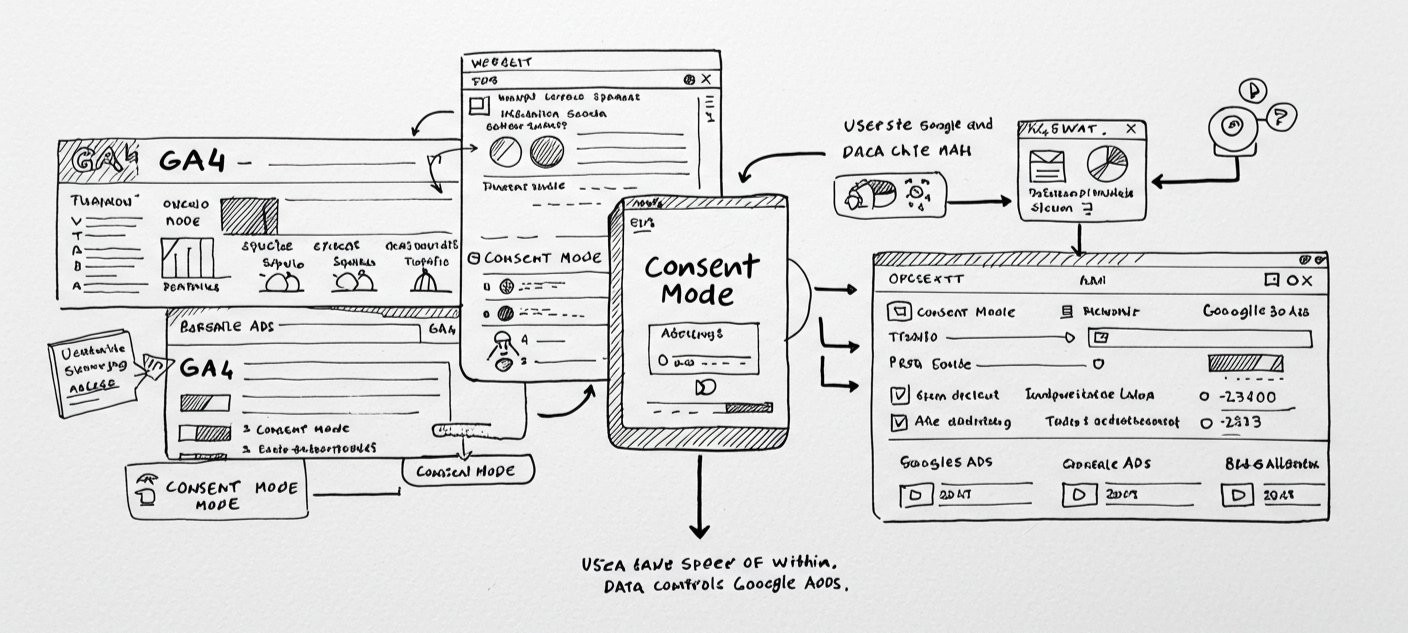
On June 15, 2026, Google is changing how advertising-related data controls work between GA4 and Google Ads. The headline: the Google Signals toggle in GA4 will no longer determine whether advertising data is shared with Google Ads. Instead, Consent Mode (specifically ad_storage) becomes the primary control for Google Ads data collection/identifier access.
Two solid summaries worth sharing internally:
- Search Engine Land: Google simplifies Analytics and Ads consent rules
- Search Engine Roundtable: Google Ads Google Analytics data controls update
If you’re a CMO, this affects how confidently you can read ROAS and conversion performance. If you own compliance, it affects whether your site may collect and use advertising identifiers in ways your organization didn’t intend (or hasn’t disclosed).
What’s changing on June 15, 2026 (in plain English)
Google Signals is no longer the “ads sharing switch”
Historically, teams often treated GA4’s Google Signals setting as a practical privacy control for advertising-related sharing. Starting June 15, 2026, that mental model breaks:
- Google Signals becomes primarily a GA4 reporting setting (identity-related reporting, cross-device, etc.). (See: Search Engine Roundtable’s summary)
- Google Ads advertising data access will be governed by Consent Mode, primarily
ad_storage. (Google’s doc: Consent mode overview)
Why it matters: this is a governance change, not a UI cleanup
From a risk standpoint, this change increases the chance that:
- marketing thinks “Signals is off, so we’re good,” while
- the CMP/Consent Mode defaults still allow
ad_storage=granted, - resulting in Ads measurement identifiers being used anyway.
That’s not a moral judgment—it’s a very real operational failure mode that shows up when settings live in different tools owned by different teams.
The new control that actually matters: Consent Mode and ad_storage
Consent Mode is Google’s framework for controlling tag behavior based on user choices. It sends consent states for different categories, including:
ad_storage(advertising storage)analytics_storage(analytics storage)
Google’s official documentation explains how Consent Mode communicates “granted” or “denied” for each consent type and changes tag behavior accordingly: Consent mode overview.
What CMOs should know
- If
ad_storageis granted, you generally preserve stronger attribution and campaign optimization signals. - If
ad_storageis denied, your Google Ads reporting may show more gaps and rely more on modeled measurement (depending on setup and eligibility).
This is why this update can look like a “privacy simplification” and a “performance disruption” at the same time. (Search Engine Land’s “why we care” section is a good non-technical explainer: Google simplifies Analytics and Ads consent rules.)
What compliance leaders should know (US + EU lens)
In the EU/EEA and UK (GDPR + ePrivacy)
Consent expectations for advertising storage and profiling are higher, and misconfigured defaults can create real exposure. Third-party tracking has been scrutinized by regulators for years, including Google Analytics-related transfer concerns.
Two examples often cited in privacy circles:
- Italy’s DPA decision (June 2022) coverage: Hunton Andrews Kurth’s GDPR-tag roundup referencing the Italian Garante’s June 23, 2022 position
- CNIL-related enforcement coverage (France, 2022): MLex’s summary of the CNIL formal notice
Even if your legal position differs, the operational takeaway is consistent: your consent implementation must match your disclosures and your intended data minimization.
In the US (state privacy laws + brand trust)
While the US is less uniform than the EU, many organizations still choose an “EU-grade” approach for simplicity and trust. The bigger US risk for CMOs is often less about regulatory headlines and more about:
- inconsistent measurement across channels,
- stakeholder confusion,
- and reputational risk if disclosures don’t match reality.
The most common failure mode we see: consent is “configured” but not “enforced”
A Consent Mode setup can look correct in a dashboard and still behave incorrectly in production because of:
- tag sequencing (tags fire before consent defaults are set),
- mis-mapped CMP categories,
- conflicting GTM consent settings,
- or missing v2 signals for EEA/UK traffic.
If you want a technical deep dive, Google documents the implementation approach and requirements in their setup guide: Set up consent mode on websites.
Also worth flagging for leadership: Consent Mode enforcement issues can create irreversible reporting gaps. Here’s a recent industry example: Consent Mode V2 enforcement is silently breaking Google Ads conversions.
A CMO-ready action plan (with compliance baked in)
1) Decide your organization’s consent posture (don’t let it drift)
Before you touch tags, align internally on one of these positions:
- Privacy-forward: deny by default, opt-in required for advertising storage (common for EU-first brands)
- Performance-forward: grant where allowed, with tight disclosure and easy opt-out (more common in some US contexts)
- Hybrid: geo-based or risk-based rules (often best, but hardest to implement cleanly)
This avoids the “silent drift” problem where performance pressure slowly changes consent behavior without governance signoff.
2) Audit Consent Mode defaults and live behavior (not just settings)
Specifically verify:
- What is the default
ad_storagestate on first page load? - Does the banner choice reliably switch it?
- Are any marketing tags firing before Consent Mode defaults are set?
Industry reporting has highlighted that Consent Mode misconfiguration can quietly break conversion reporting and create permanent data gaps: PPC Land’s investigation.
3) Update privacy and cookie disclosures before June 15, 2026
If your policies reference “Google Signals” as the primary control for advertising sharing, update them to reflect the new reality:
- Consent Mode / CMP consent signals (especially
ad_storage) determine Ads identifier usage behavior.
If you need a compliance partner that bridges legal + technical implementation, TopOut is an iubenda Silver Partner—built specifically around operationalizing cookie banners, consent records, and policy workflows across EU and US requirements
4) Run a cross-tool governance check: GA4, Google Ads, GTM, CMP
After June 15, 2026, privacy outcomes are no longer mainly “a GA4 admin setting.” They’re a system:
- CMP configuration
- GTM container and consent initialization
- GA4 configuration
- Google Ads linking and tag behavior
If any one owner changes their piece without coordination, you can drift out of compliance or lose measurability.
5) Create an executive reporting note (so your board deck doesn’t get blindsided)
For the reporting period around June–August 2026, add a footnote to performance reporting that acknowledges:
- consent implementation changes may shift attribution visibility,
- modeled vs observed conversion composition may change,
- and benchmarks may need recalibration.
This is the difference between “data volatility” and “data-informed leadership.”
What this means for SEO, paid media, and measurement strategy
- Paid media: Your ability to optimize and explain performance will increasingly depend on correct Consent Mode implementation (not just GA4 settings). If paid is a core growth channel, see how TopOut approaches PPC advertising with measurement and governance in mind (and here’s a related perspective on making channels work together: the collaborative power of PPC and SEO).
- SEO + AEO: Privacy-safe measurement (and clean technical foundations) matter even more as brands compete for visibility across classic search and answer engines. If you’re investing in organic visibility, TopOut’s SEO & AEO services are built around technical precision and measurable outcomes.
FAQ for CMOs and compliance stakeholders
Is Google Signals going away?
Not exactly. It still exists, but its role as a practical “Ads sharing switch” changes as Google moves Ads control toward Consent Mode after June 15, 2026. (Summary: Search Engine Land.)
What do we need to control to prevent Ads identifiers from being used?
Your Consent Mode consent signal—especially ad_storage—plus correct implementation timing and CMP mapping. (Docs: Consent mode overview and set up consent mode on websites.)
Does this affect US and EU organizations equally?
The mechanics are the same, but the risk profile differs:
- EU/EEA/UK: consent requirements are stricter and enforcement risk is higher.
- US: risk is often disclosure mismatch, consumer trust, and inconsistent measurement.
Get an assessment (before June 15, 2026)
If you want a clear answer to “what are we actually collecting and sharing right now?” the fastest path is a structured audit.
TopOut’s website assessments review analytics + tagging, content, design, and technology so you can fix the root cause—not chase symptoms.