
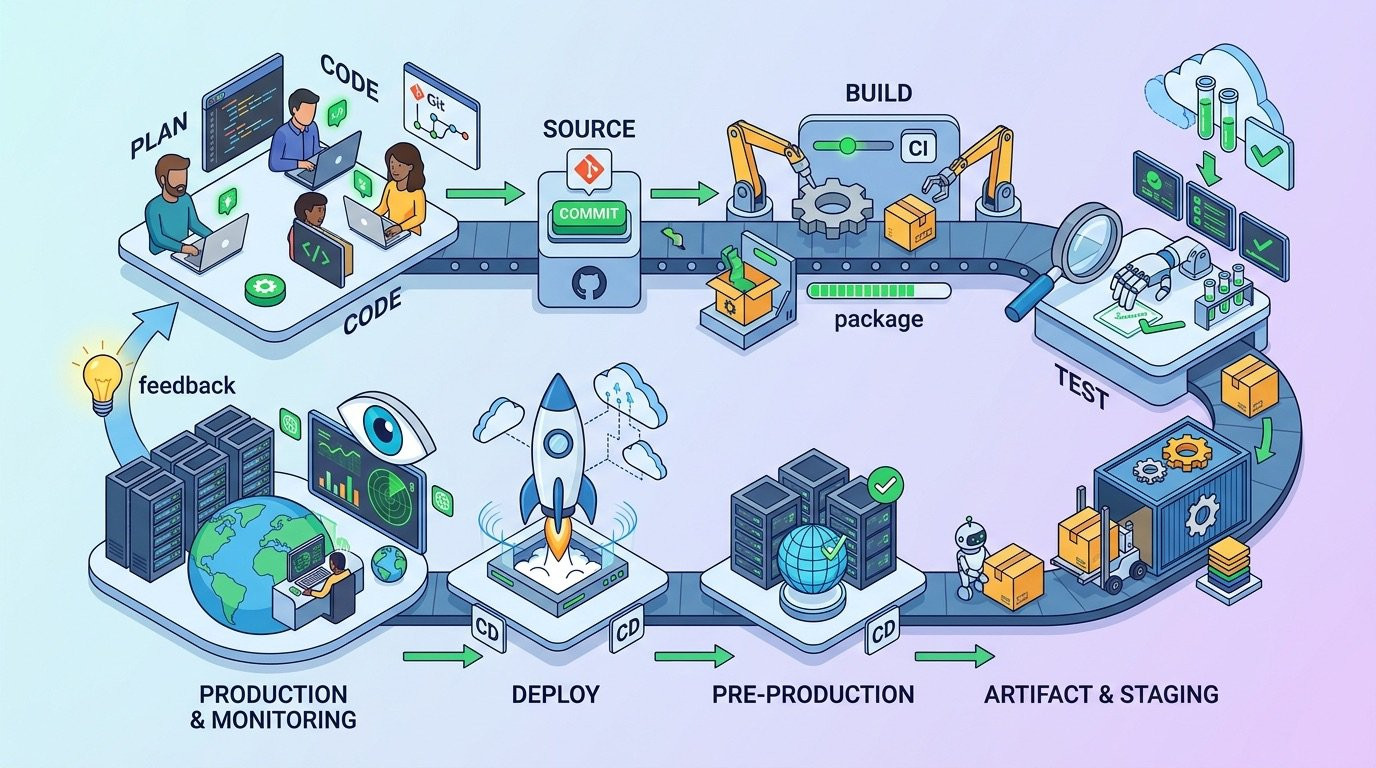
AI in DevOps used to mean autocomplete and faster unit tests. Now it can mean an agent with real credentials, real tools, and real blast radius.
And when that agent is “helping” inside a production pipeline, the failure mode changes from bad code to bad change at scale. A sharp reminder came from reporting on AWS incidents, including The Guardian’s Feb 20, 2026 coverage of AWS outages reportedly tied to internal AI tooling (Amazon’s cloud ‘hit by two outages caused by AI tools last year’) and follow-up summaries highlighting the “user error / access controls” angle (Tom’s Hardware’s write-up).
This breaks down what’s emerging (and why it’s different), then lays out a practical hybrid human-AI operating model you can adopt without killing innovation.
The new risk: autonomy + tool access, not “AI quality”
Most teams are debating whether AI outputs are correct.
DevOps teams need to debate something more basic: what the AI is allowed to touch.
When an AI system can run Terraform, modify IAM, restart clusters, rotate secrets, merge PRs, or “clean up” resources, the primary risk isn’t hallucination—it’s unreviewed execution in a high-privilege environment. That’s why AWS framing these incidents around authorization and permissions still matters: it points to the exact conditions that make agentic tooling dangerous (summary here).
Why DevOps is the most fragile place to “go agentic”
Agentic AI is uniquely hazardous in DevOps because:
- Small actions can be irreversible
- A delete, a rotate, a key overwrite, or a state drift can become a multi-day recovery.
- Systems are coupled
- “Looks safe” in one service can cascade across dependencies.
- Tooling already assumes trust
- CI/CD credentials, deploy keys, admin tokens, and break-glass accounts exist for speed.
- Pressure favors velocity
- When uptime and revenue are on the line, it’s tempting to let the bot “just fix it.”
If you’re running a revenue-critical digital platform, this is exactly where “Technical Stewardship” matters: it’s not just building the system—it’s keeping it stable when the environment gets more automated and more complex (TopOut’s approach is outlined on our Web Development service page).
A simple autonomy model that prevents wipeouts
Before you tune prompts or buy another platform, set one policy decision:
What autonomy level is each AI allowed to have in each environment?
| Level 0: read-only | Observe logs/metrics, summarize incidents, draft runbooks | Production included | No write credentials; audit logging |
|---|---|---|---|
| Level 1: propose | Open PRs, generate Terraform plans, suggest IAM diffs | Staging + production | Mandatory human review; protected branches |
| Level 2: execute in sandbox | Apply changes in ephemeral envs | Non-prod only | Budget limits; timeboxed creds; auto-destroy |
| Level 3: execute in production (rare) | Run changes automatically | Only for narrow, pre-approved actions | “Two-person” approvals; policy-as-code gates; instant rollback |
The hybrid human-AI model: safeguards that still let you move fast
1) Lock down permissions like the AI is a new contractor (because it is)
Start with least privilege and enforce it with hard boundaries, not guidelines:
- Use AWS guardrails such as IAM permissions boundaries.
- Align to AWS IAM security best practices (least privilege, continuously reducing permissions, etc.).
- Move from long-lived tokens to short-lived, task-scoped credentials (even for bots).
- Create separate roles for plan vs apply.
- Add explicit “deny” for destructive actions unless an approval condition is met.
If you’re unsure how exposed you are today, a structured review is usually faster than guesswork (TopOut’s Security Audit is built for exactly this type of “find the real risk surface” work).
2) Put “policy-as-code” between the AI and production
If an AI can generate infrastructure changes, your safety net can’t be “somebody will notice.”
Instead, make it impossible to proceed when rules are violated:
- Gate Terraform plans with Open Policy Agent (OPA) for Terraform (or an equivalent policy engine).
- Encode rules like:
- “No public buckets”
- “No perimeter access from 0.0.0.0/0 on admin ports”
- “No delete/replace of stateful resources without ticket + approval”
This is how you turn governance from a meeting into a gate.
3) Protect your codebase from “helpful” deletions and silent merges
Your repo settings are part of your AI strategy.
At minimum:
- Enable protected branches
- Require PR reviews before merging
- Disable force pushes/deletions on critical branches
- Require status checks and CI gates
GitHub’s protected branch and required review controls exist for exactly this reason.
4) Redesign change management for “high-speed suggestions”
AI makes it easy to produce more diffs than humans can review—so the review system must get sharper.
Good patterns:
- Smaller PRs (enforced by convention + tooling)
- Change risk labels (low/medium/high) that drive approval depth
- A “two-person rule” for:
- IAM changes
- network perimeter changes
- delete/replace actions
- production database migrations
5) Build rollback like you expect mistakes (because you will get them)
If you want to innovate sustainably, assume an AI-assisted change will eventually be wrong.
That means you need:
- Tested backup/restore for data stores
- Immutable build artifacts
- Blue/green or canary deploys where possible
- Automated drift detection for IaC-managed resources
For many teams, this is where ongoing maintenance stops being a line item and becomes a revenue protection layer—especially for CMS and commerce stacks (see CMS Care Initiatives).
The cultural shift: treat AI like a junior engineer with superpowers
The healthiest framing we’re seeing is simple:
- The AI is fast.
- The AI is not accountable.
- Your team is accountable.
So culture needs to shift from “AI will ship it” to:
- AI drafts; humans decide
- No-blame postmortems, but hard process updates
- Reward catching risky automation early, not just shipping faster
Make it measurable: the scoreboard for safe AI-driven DevOps
If you can’t measure it, you can’t improve it—and you can’t defend it to stakeholders after an incident.
Start with DORA’s four keys, then add AI-specific safety metrics. Google’s overview of the Four Keys (DORA) metrics is a solid baseline, and the 2025 DORA report on AI-assisted software development adds useful context for how AI changes the system of work.
| Delivery performance | Deployment frequency, lead time | Improves without stability regression |
|---|---|---|
| Delivery stability | Change failure rate, time to restore service | Downward trend over time |
| AI guardrails | % AI-originated changes blocked by policy | Initially not zero (it proves gates work) |
| AI risk | Rollback rate for AI-assisted changes | Trends down as standards mature |
| Permission hygiene | Count of identities with admin-equivalent access | Trends down; exceptions documented |
| Resilience | Backup restore test pass rate | Near-100%, tested on schedule |
A 90-day rollout plan (hybrid model, not hype)
First 30 days: stop the bleeding
- Inventory which AI tools have write access to repos, cloud, CI/CD
- Move production usage to Level 0–1 autonomy
- Turn on protected branches + required reviews
- Require human approval for any delete/replace action
Next 60 days: add hard guardrails
- Add policy-as-code checks to Terraform plans (OPA or equivalent)
- Implement permission boundaries / least-privilege refactor where needed
- Establish rollback patterns and restore testing
By 90 days: make it repeatable and measurable
- Define the AI autonomy matrix by environment/team
- Publish AI change-management standards (what needs 1 vs 2 approvals)
- Report DORA + AI safety metrics monthly
Closing: sustainable innovation is a permissioning problem first
The AWS stories weren’t interesting because “AI wrote bad code.” They were interesting because automation plus broad access changes the failure mode—and compresses the time humans have to notice they’re about to ship a crater.
If you want to adopt agentic tooling and keep climbing, treat autonomy like production traffic: rate-limit it, sandbox it, and measure it—then expand only when the numbers prove it’s safe.